In Finance We Spend Billions a Year Reconciling Notes. Daml Explains Why.
Post-trade settlement burns billions annually not on moving money but on institutions comparing what each of them wrote down about the same event. A public blockchain does not fix it - a broker cannot see a competing broker's book. Daml, born from an ASX rebuild, gives a different answer: shared process, separate views.
Billions a year on reconciling notes
You tapped "buy stock". The app shows the trade is done. For the next two days, a dozen institutions are quietly reconciling with each other what actually happened. Your broker holds one version. The seller's broker holds another. The clearing house holds a third, the CSD a fourth, both banks a fifth and sixth. Each of them keeps its own ledger where it writes the same event in its own words. Then everyone compares notes. When the notes disagree, someone calls, someone emails, someone opens a spreadsheet and hunts for the difference. That is settlement, and globally it costs billions of dollars a year. Not to move money. To check that everyone has written down the same thing (the same reconciliation drag that motivates the SWIFT-vs-blockchain debate in cross-border payments).
The obvious idea that does not work
If the problem is that everyone keeps their own ledger, the fix looks obvious: one shared ledger. As a card-carrying distributed-technology fanboy, my instinct is: blockchain. The catch is that a public blockchain solves it in a way an exchange cannot accept. For anyone to verify the ledger is true, everyone has to see it. In financial markets, half the participants are not allowed to see the other half. A broker cannot look at a competing broker's positions. That is a foundation of fair markets and it is a hard regulatory line. Knowing who holds what is worth money and lets you trade against people. So an open shared ledger fixes one problem by creating a second, worse one.
The answer built for an Australian exchange
In 2016 the Australian stock exchange ASX contracted Digital Asset to replace its post-trade settlement system. The brief was to build a shared ledger for all participants where nobody would see anything beyond what concerns them. It turned out there was no tool that could express that. So Digital Asset built one and called it Daml, and later - in 2019 - released it publicly and for free. Daml is not a database and not a network. It is a language you write the substance of a contract in, in a way that a computer understands not only the terms but also who has the right to know they exist. The same permissioning model shows up in tokenised real-world-asset architectures, where regulated issuers need shared state without full public disclosure.
What the trick actually is
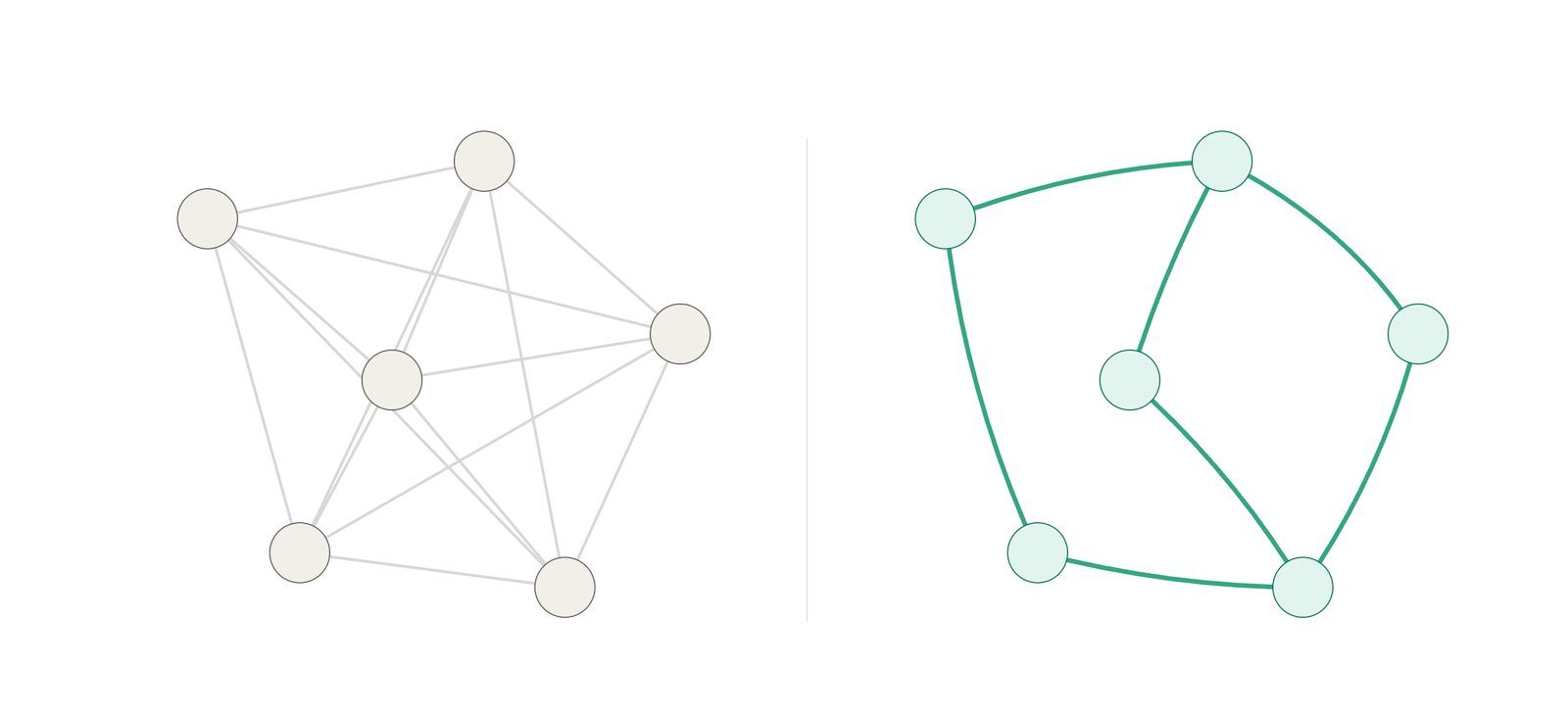
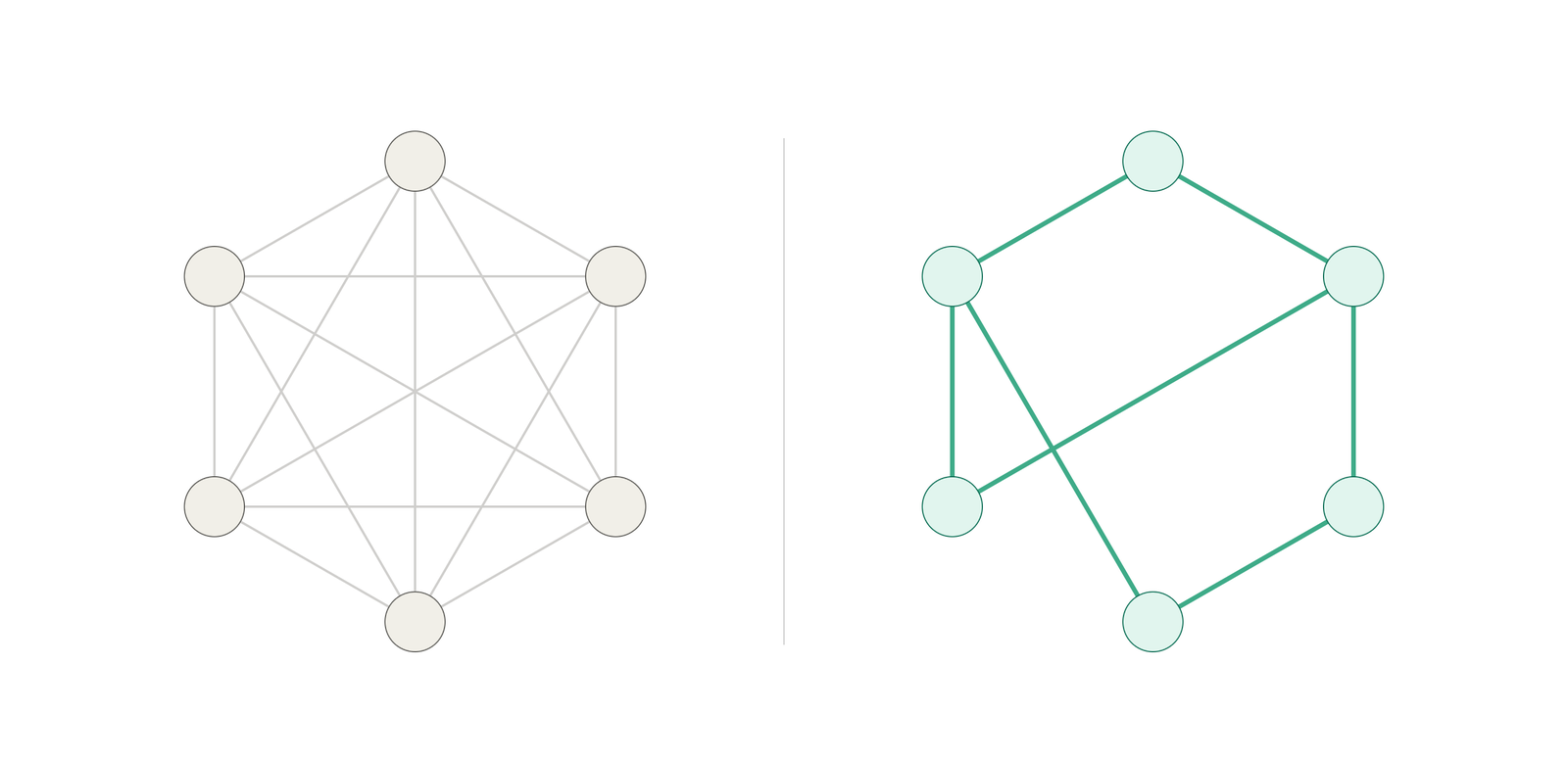
Left: mesh - everyone reconciles with everyone. Right: subset - each party sees only what concerns them.
A transaction is not one document. It is a set of linked records, each of which is delivered only to the parties it concerns. The buyer's broker gets the record for their side of the operation. The seller's broker gets the record for theirs. The clearing house, a party to both, gets both. The brokers do not see each other. Nobody sees the whole, but every single fact is witnessed by the full set of parties it concerns. Every record has at least two witnesses, and the records interlock like chain links. Nobody sees the whole chain, and the chain still holds. The fragments meant for one broker never reach the other.
Not only an exchange problem
Settlement is just the cleanest example of a pattern. Once you notice it, it is everywhere:
The same multi-party pattern repeats across finance, insurance and healthcare - shared process, different views.
✓Syndicated loan. An agent, a dozen lenders, one borrower. Every participant knows their own tranche and has no right to see the others' terms. Today it runs on email and spreadsheets, and reconciling who owes whom what can take weeks.
✓Insurance claim. Customer, agent, insurer, loss adjuster, reinsurer. One case, five parties, five different scopes of access to the same story.
✓Letter of credit in cross-border trade. Buyer, seller, two banks, carrier, insurer. Classic multilateral contract where everyone sees a different slice, still largely paper-driven.
✓Healthcare. The clearest proof this is not really about finance. Among the firms testing Daml before its public release, alongside exchanges and banks, were healthcare companies. Patient, hospital, insurer, payer all participate in one settlement flow, and the patient's data is visible only to those with the right to see it.
✓Bank customer KYC. One customer, one set of documents, several banks - each seeing only its own relationship with that customer. A problem obvious to anyone who has opened business accounts at three institutions and delivered the same corporate certificate three times.
✓Supply chain. Manufacturer, carrier, insurer, buyer, customs. Same container, six different scopes of knowledge about it.
Worth knowing: Daml never required a blockchain. It ran equally well on an ordinary database. A shared process with separate views is an organisational problem, not a technological one - and a distributed ledger is one of several ways to solve it, not a prerequisite.
Three things Daml does differently
Three architectural choices that separate Daml from every general-purpose smart contract platform:
✓A contract nobody signed cannot exist. In Daml this is not checked, because it cannot be circumvented. A contract without the full set of signatures simply does not come into being - like a printer that refuses to print a document missing an initial. A whole class of errors that would normally be caught by audit disappears.
✓Nothing is erased. Contracts are not edited. Changing terms means closing the old one and creating a new one in its place. Accountants have known this rule for five hundred years: you do not erase a wrong entry, you post a reversal. History is built into the design, not bolted on as a log someone could clean up. When audit or dispute arrives, the full trail exists, because it could not have been otherwise.
✓Permission is itself a contract. In a typical system, permissions live in a table: this user is an admin, that one is an accountant. Someone filled in the table once and by now nobody remembers why. In Daml, granting someone the right to act on your behalf is a separate contract - with a date, a condition, and an expiry. The question "why was this person allowed to do this" always has an answer in the form of a document, not a row in a table.
What Daml deliberately cannot do
You cannot write a website in it. You cannot send an email. You cannot fetch an FX rate from the internet. It does not even have access to a clock. That is on purpose. If a dozen organisations are meant to compute the same thing independently and arrive at an identical result, the computation cannot contain anything that would come out differently for each of them. It is enough that one of them checks the clock a second later, and the results diverge. And divergence between institutions is not a bug - it is a dispute. The language does exactly one thing: it records what the parties agreed and who can do what with it. A bit like chess notation, which can record every game ever played and cannot order a pizza. The rest of the system - UI, integrations, notifications - is written in ordinary languages and sits alongside.
Daml grew out of Haskell - like Plutus, but pointed the other way
Daml grew out of a language from the academic tradition, prized where a bug costs too much to catch in production. From the same root grew Plutus, the smart contract language of the Cardano blockchain. Same lineage, opposite answers.
Plutus is a bouncer at the door. Someone brings a ready-made transaction, Plutus checks the papers and says yes or no. Everything happens in public, because that is what Cardano is for: anyone can verify anyone.
Daml is a law firm. It does not judge a document brought to it. It drafts the document from the substance of the agreement, collects signatures, and sends each party its own excerpt with the right scope.
Plutus answers the question "is this allowed?". Daml answers "what is happening and who knows about it?"
Neither is better. They are answers to two different questions, asked by two different worlds.
Not trustlessness. Selective disclosure with accountability.
For a decade the conversation has been about how to build a system where no one has to trust anyone else. That makes sense with anonymous participants. It loses its sense when the other side is a licensed bank, a supervised insurer, and a hospital with a duty to protect patient data. They trust each other professionally, on the basis of regulation and liability. Their problem sounds different: who sees what, and how do we know it agrees.
If any of the patterns above are your problem - multiple parties, one shared process, different scopes of access - happy to talk. Binar has been working with Digital Asset's Daml and adjacent tooling since the early days, and we know the tradeoffs the pitch decks skip.